
About This Report
The Middle Market Indicator (MMI) from the National Center for the Middle Market is a quarterly business performance update and economic outlook survey conducted among 1,000 C-suite executives of companies with annual revenues between $10 million and $1 billion. The health of these businesses and their respective outlook serve as a solid indicator for the greater U.S. economy as a whole. (See www. middlemarketcenter.org: “The Market that Moves America,” seminal research on the definition, significance, and role of the middle market, Oct. 2011.) This report, developed in collaboration with Dietrich Partners, is derived from the bi-annual MMI survey conducted over the last five years and represents an analysis of data from 50-100 different Rocky Mountain region middle market companies each year. In addition to the survey-based data, this report reflects insights and highlights from qualitative discussions with senior leaders from area businesses operating in a variety of industries.
The Rocky Mountain Region Middle Market
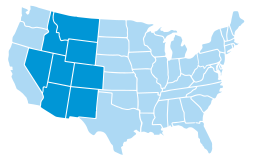
The Rocky Mountain region middle market is composed of more than 10,200 companies located in the states of Wyoming, Idaho, Montana, Nevada, Utah, Colorado, Arizona, and New Mexico. These companies span all industries and ownership types and represent the full middle market revenue spectrum. Collectively, the businesses employ 2.8 million people in the region and generate a total of $498 billion in annual revenues, making the middle market a vital contributor to the local economies in the region.
How Is the Research Conducted?
The MMI surveys 1,000 CEOs, CFOs, and other C-suite executives of America’s middle market companies on key indicators of past and future performance in revenues, employment, and allocation of cash. The survey also reports on middle market company confidence in the global, U.S., and local economies and identifies key business challenge areas. In 2020, the survey included questions specific to the current and future impact of COVID-19. The survey was designed to accurately reflect the nearly 200,000 U.S. businesses with revenues between $10MM and $1B, the lower and upper limits on middle market annual revenue. The survey is designed and managed by the National Center for the Middle Market.
After survey data is collected, responses are categorized by region to provide a snapshot of regional performance and outlook. These regional data are compared to data for the U.S. middle market collected over the same time period.
Performance
Executive Summary
In the Rocky Mountain region, and across the country, middle market businesses—those with annual revenues between $10 million and $1 billion—are a powerful economic engine, consistently outperforming larger and smaller companies from a revenue growth perspective, providing a disproportionate share of jobs, and driving the health of local economies. From a historical perceptive, Rocky Mountain region middle market businesses have enjoyed stronger performance than their peers in other areas of the country, posting more aggressive year-over-year revenue and employment growth rates between 2016 and 2018.
Of course, middle market businesses in the region, like their counterparts across the nation, were in no way immune to the tumultuous events of 2020. According to our survey, 23% of companies said that business performance deteriorated in 2020; just 13% reported a decline in performance over the course of 2019. Perhaps more telling, just 43% of Rocky Mountain region middle market companies indicated that overall year-over-year performance had improved. This number represents a dramatic decline from the 76% of area businesses that said the same at the end of 2019.
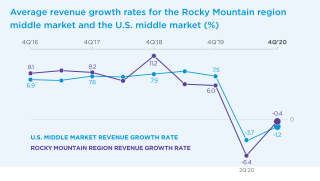
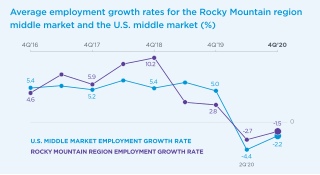
As was the case across the country, the historic year did not affect all companies equally, but the cumulative impact was a dramatic decline in performance compared to previous years. Between December 2019 and December 2020, 40% of businesses in the region experienced negative year-over-year revenue growth and 34% of companies shed jobs (compared to 38% and 32%, respectively, for the U.S. middle market). Collectively, however, the region’s middle market businesses reported a -0.4% decline in revenues and a -1.5% decline in the rate of employment for the period. In comparison, for the four years prior to 2020, the Rocky Mountain region middle market enjoyed an average rate of year-over-year revenue growth of 7.7% and an average rate of year-over-year employment growth of 5.9%.
Despite the notable declines in the top line, not all of the news was negative. Several middle market business leaders from the region, with whom we spoke to supplement our quantitative survey data, said expense control and cost efficiencies allowed them to exceed profitability expectations in 2020 even while dealing with revenue challenges.
Looking ahead to 2021, many local middle market leaders indicate that the impact of the pandemic will be severe for some time. Economic confidence is significantly lower than it was one year ago and companies are much more conservative when it comes to investing their cash. A few leaders expressed growing concern about the uneven rollout of government stimulus and how future policy may favor industries in different ways. Similarly, there was more latitude and flexibility given to both customers and vendors, with an “all in this together” point-of-view. Will that change going forward? And if so, how?
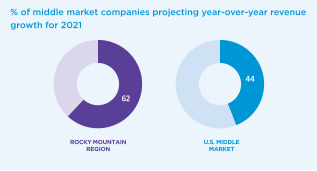
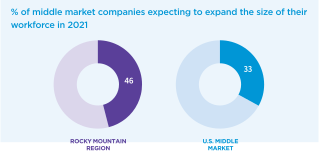
Still, middle market executives in the region are decidedly optimistic about their futures. Three out of five Rocky Mountain region middle market businesses say they will experience positive revenue growth over the next 12 months; nearly half have plans to add new jobs. Additionally, leaders we spoke with talked about fundamental shifts in strategic thinking and proactive decision-making versus pre-pandemic approaches, which should help accelerate growth as recovery continues.
Compared to national averages, projected rates for both revenue and employment growth for 2021 are much more robust in the Rocky Mountain region. Local executives appear to believe their businesses are firmly on the path to recovery and are well-positioned to overcome challenges, take advantage of new growth opportunities, and resume their position as strong contributors to their local and national economies.
2020 Performance
Revenue
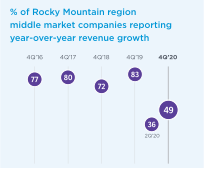
Year-over-year top line revenue for the Rocky Mountain region middle market declined on average by -0.4%, compared to -1.2% for the U.S. middle market. Nearly half of companies (49%) in the region reported revenue growth for the period while 40% saw revenues decline.
Employment
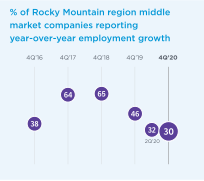
Year-over-year employment in the Rocky Mountain region middle market declined by -1.5% compared to -2.2% for the U.S. middle market. Thirty percent of Rocky Mountain region companies increased the size of the workforce while 34% of companies eliminated jobs.
Regional Company Spotlight
Galloway & Company, Inc.
Gallowayus.com
Headquartered in Denver, Colorado, Galloway is a full-service architecture and engineering company that supports local developers as well as national expansion programs. While the company’s building design related services experienced significant declines in revenue in 2020, other areas of the business, such as engineering, grew by servicing grocery and fast-food restaurant chains. Galloway finished 2020 with 20% year-over-year revenue growth while increasing full-time employment from 153 to 183 employees. Company leaders attribute success to “being in the right place at the right time” and never slowing down business development efforts despite challenges.
Executive Sentiment
Confidence
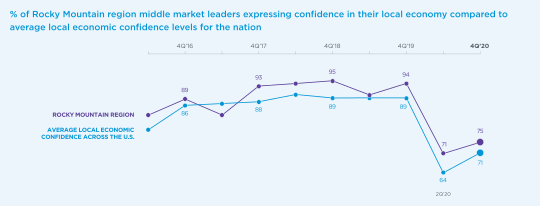
Middle market executives place more confidence in their local economies than they do in the national or global economy. Historically, Rocky Mountain region leaders express a higher level of local confidence than their peers in other parts of the country.
Regional Company Spotlight
Organic Dairy Farm
At an organic dairy farm in Colorado, consumers can buy dairy products made without synthetics and with great care for dairy animals and farmland. Overall, the pandemic has been good for the farm’s business, creating a surge in demand for its products with more people eating at home. Yet, 2020—and the month of March in particular—was one of the most challenging the company has ever faced.
The operation experienced its first COVID-19 case in a plant in the second week of March, before much CDC guidance existed. Leadership immediately decided to ramp up communication efforts and put out as much information as possible in order to stay connected to employees and protect the workforce. They began reporting how many people were sick, how the company was addressing the issues, changes to policies and procedures, and new laws on benefits and pay. The dairy invested heavily in IT and PPE. And it invested in its people. It strengthened paid time off policies for families dealing with illness while implementing bonuses and incentive pay to keep farmers and manufacturing facilities producing.It subsidized childcare to assist families with online school situations. And it sent groceries once a week to employees who were out sick with COVID-19.
These efforts helped the company deliver on its 2020 strategy and have created a positive long-term outlook. A re-entry plan is in the works for the corporate office, and the company continues to over-communicate to help with the challenge of maintaining the human connection. While re-establishing a sense of community in an era of social distancing and remote working won’t be easy, the dairy’s CFO is optimistic. “I feel good and the overall feeling from the team is positive. There is a healthy sales pipeline and commitments on products, lots in development, and ongoing requests from customers who are looking for different things.”
Capital Investment
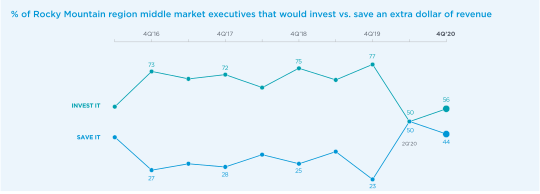
After reaching a five-year low in 2Q’20, appetites for investment remain conservative with just 56% of Rocky Mountain region middle market businesses willing to put an extra dollar to work immediately while 44% continue to prefer holding cash.
Regional Company Spotlight
Buehler Moving Company
buehlercompanies.com
Buehler Moving Company services a variety of markets including commercial, military, and residential moving. Despite a year-over-year revenue decline of 7%, company leaders saw 2020 as a good opportunity to invest in two areas: IT infrastructure to support remote working and new equipment to position the business to meet the increased demand for over-the-road trucking and logistics. Even with total investments of nearly $2 million in these areas, the company has plenty of cash reserves, thanks to cost-cutting actions and a savings plan put in place specifically to finance year-end bonuses.
2021 Outlook
Projected Revenue Growth
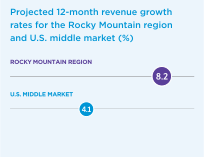
A majority of Rocky Mountain region middle market businesses expect healthy revenue growth in 2021 with an average projected revenue growth rate of 8.2%, double the U.S. average. This growth projection is the highest recorded for the region and significantly above the average regional projection of 5.1%.
Projected Employment Growth
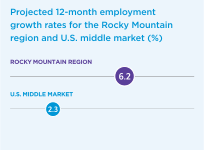
Nearly half of Rocky Mountain region middle market businesses expect to expand the size of their workforce in 2021 with an average projected employment growth rate of 6.2%, nearly three times the national projection.
Regional Company Spotlight
PEAK Resources
peakresources.com
PEAK Resources is a 30-year-old Colorado-based technology and systems integrator focused on the next generation of data center designs. While 2020 saw a significant reduction in revenues for the firm, the company was able to maintain its employment and even pick up top talent from other companies doing layoffs. This was possible largely due to reducing leadership team salaries. This strategy has positioned the company well for 2021, and it is optimistic about growth, thanks to a strong backlog of opportunity created by business deals delayed in 2020. While the business is realistic about ongoing challenges, PEAK Resources has set a stretch budget with the goal of revenue increases of 25-30% in 2021.
Challenges
Current and Future Impact of COVID-19
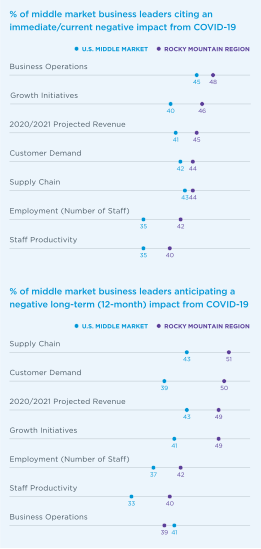
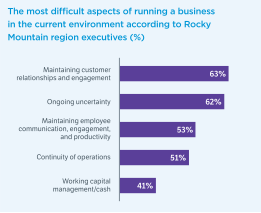
For middle market business leaders in the Rocky Mountain region and across the country, the COVID-19 pandemic remains the top external challenge with the potential to continue affecting current and future business performance.
Regional Company Spotlight
National Corporate Housing
nationalcorporatehousing.com
National Corporate Housing is a global company providing temporary furnished apartments for executives, employees, and people relocating to new cities and working away from home base for extended periods. After a record-setting first quarter, the company saw revenue decreases of approximately 30% across all business lines. To ensure financial stability, executives took aggressive actions that included management pay reductions, staff furloughs and reductions, office lease negotiations and terminations, negotiating cost savings with its supply chain partners, and pursuing new banking relationships to secure more flexible lending parameters. Forecasting frequency changed from monthly to every 72 hours with a heavy emphasis on finding new clients, new demand, and new opportunities to “grow the pie.” In addition, to immediately boost earning, the company has focused on several opportunistic acquisitions.
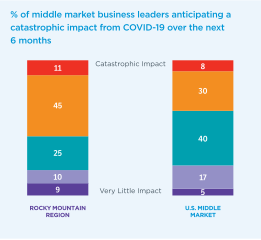
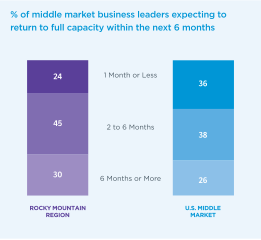
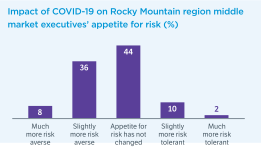
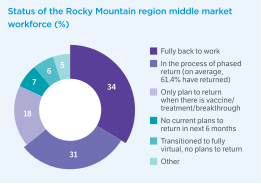
More than half (56%) of Rocky Mountain region middle market business leaders classify the pandemic’s impact as catastrophic to some degree compared to 38% of middle market leaders across all areas of the country. In the Rocky Mountain region, a third of employees are back to work in-person, but it will take months for most companies to return to capacity and many will move forward with more caution and less tolerance for risk.
DE&I
Policies and Practices
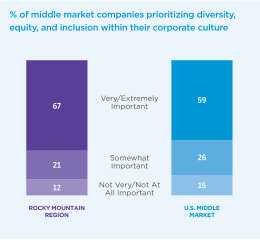
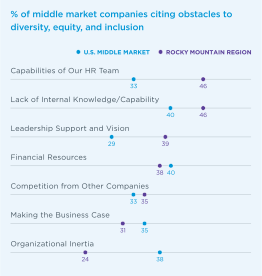
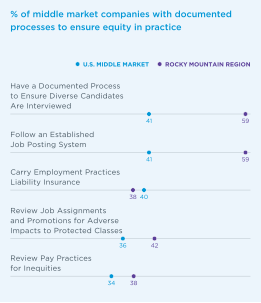
Rocky Mountain region middle market businesses are more likely than their peers in other parts of the country to prioritize DE&I and to have policies in place to create a more inclusive and equitable workforce. In the region, many companies indicate the need to gain additional knowledge and skills to advance DE&I efforts.
Perspectives
The National Center for the Middle Market has been keeping a pulse on the performance, sentiment, challenges, and opportunities of middle market companies for nearly 10 years. While we tend to focus our attention on the economic segment as a whole, our survey process allows us to look at these companies in different ways, such as by industry sector, ownership type, or revenue size. Regional differences are also important to understand, and we are proud to have collaborated with Dietrich Partners on a view of the Rocky Mountain region middle market. The combination of quantitative data and qualitative interviews with C-suite executives at firms in this region has provided an interesting look into the performance and outlook against the balance of the U.S. middle market.
Regional performance
What have we learned? First, performance of Rocky Mountain region middle market companies in terms of revenue and employment growth has historically outpaced the rest of the middle market. Interestingly, that trend took a dip throughout 2019, where average revenue growth was 6.5% for the region versus 7.7% for the entire country. Similarly, employment growth was approximately 2.7% during the same period while the rest of country averaged a more robust 5.6%. We know from prior research that access to talent has been a challenge for middle market companies for a number of years. Given the historically low unemployment rate, perhaps the slower growth to headcount is less surprising. What was surprising is how the region bounced back during the chaos of 2020. While pain was generally felt across the country, the Rocky Mountain region did comparatively better. Revenue decline was only -0.4% (as opposed to -1.2% for the U.S. middle market) and employment declined -1.5%, about a third less than for all midsize companies nationwide.
Discussions with company leaders helped shed light on these results. While no one could say they were fully prepared, we learned about tactics that helped fortify these businesses in the short term. Culture appears to have played a central role in the responsiveness, flexibility, and resilience of the workforce. Many leaders shared stories of an “all-in” attitude from the top-down with employees taking on various new responsibilities to keep things afloat. Subsequently, many businesses quickly implemented more flexibility in sick leave to care for family members, and those who froze pay increases eventually ended up rewarding their staff with year-end bonuses in appreciation for their efforts. Communication—both internal and external— also proved to be critical as companies transitioned through the various changes that came with managing the pandemic. Some said experience within the leadership team, gained during previous recessions and downturns, was helpful in keeping perspective on the long-term. In other cases, advisory boards became more active and communicative with guidance and with streamlining approval processes for working capital. Finally, investment into key platforms and tools was a consistent theme; in fact, several businesses made multi-million dollar investments toward infrastructure, IT, customer management systems, and more.
Capital investment
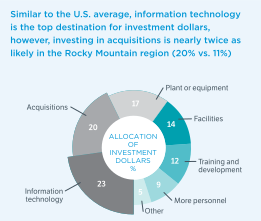
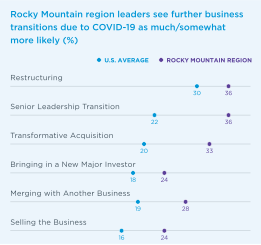
Our data, supported by qualitative discussions, shows the Rocky Mountain region middle market is poised to invest in transformative acquisitions and opportunities. We asked survey respondents what they might do with an additional dollar of revenue. While 44% of companies said they would save it, a majority would put the money to work immediately. Among the investors, 20% would focus on acquisitions. This is significantly higher than the U.S. average of 11%. In addition, when we asked about the impact of the pandemic on business transitions, a third of company leaders said they would be more likely to make a transformative acquisition. Finally, we saw that more than 40% of Rocky Mountain region middle market businesses are leaning on their trusted advisors (bankers, lawyers, and accountants) who could support the M&A process.
Our interviews with leaders in the region supported these data points. In addition to some of the capex investments made directly into the business, Rocky Mountain region middle market executives continue actively looking for external investment opportunities. Even though sufficient capital exists and borrowing rates remain low, evaluations have held their ground, creating some pause when looking at opportunities and presenting a possible roadblock. Despite this, a number of businesses have started looking at different regions outside of the Rockies for potential expansion.
Diversity, Equity and Inclusion
For the first time, the Center explored the topic of Diversity, Equity, and Inclusion (DE&I) as part of the Middle Market Indicator survey. While we found this topic to be top-of-mind across the country—in fact, nearly three out of five companies said it was very important to them—the Rocky Mountain region views were even stronger. More than two-thirds of companies in the region place significant importance on DE&I efforts, and over 70% stated that DE&I is explicitly included as part of their company values. Across the board, companies in the region have a stronger pointof- view in terms of anti-discrimination, commitment to those with disabilities, regular access to training and education, and creating, measuring, and communicating DE&I metrics. For example, nearly 60% of Rocky Mountain region middle market companies said they have a process for ensuring diverse candidates are interviewed for open positions; the national average is just 40%.
Once again, the leaders we talked with seconded the data insights. One of the challenges of the remote work environment has been maintaining the strong culture and DE&I initiatives that, in many cases, have taken years to build. Talent development, orientation and on-boarding, and regular gatherings like staff meetings are avenues to communicate and highlight DE&I updates. In a virtual setting, sharing this information is harder, but companies are looking for creative ways to continue to keep the message front and center. Many companies told us they have also changed their stance about speaking out regarding social issues; in the past, it was better to stay quiet. But employees, customers, and the community no longer see silence as acceptable. Finally, DE&I has also filtered down to customer engagement with a stronger focus in many organizations on training for pronoun use and transgender interactions. As a whole, these actions are no longer viewed as going above and beyond; they are table stakes in today’s business environment.
